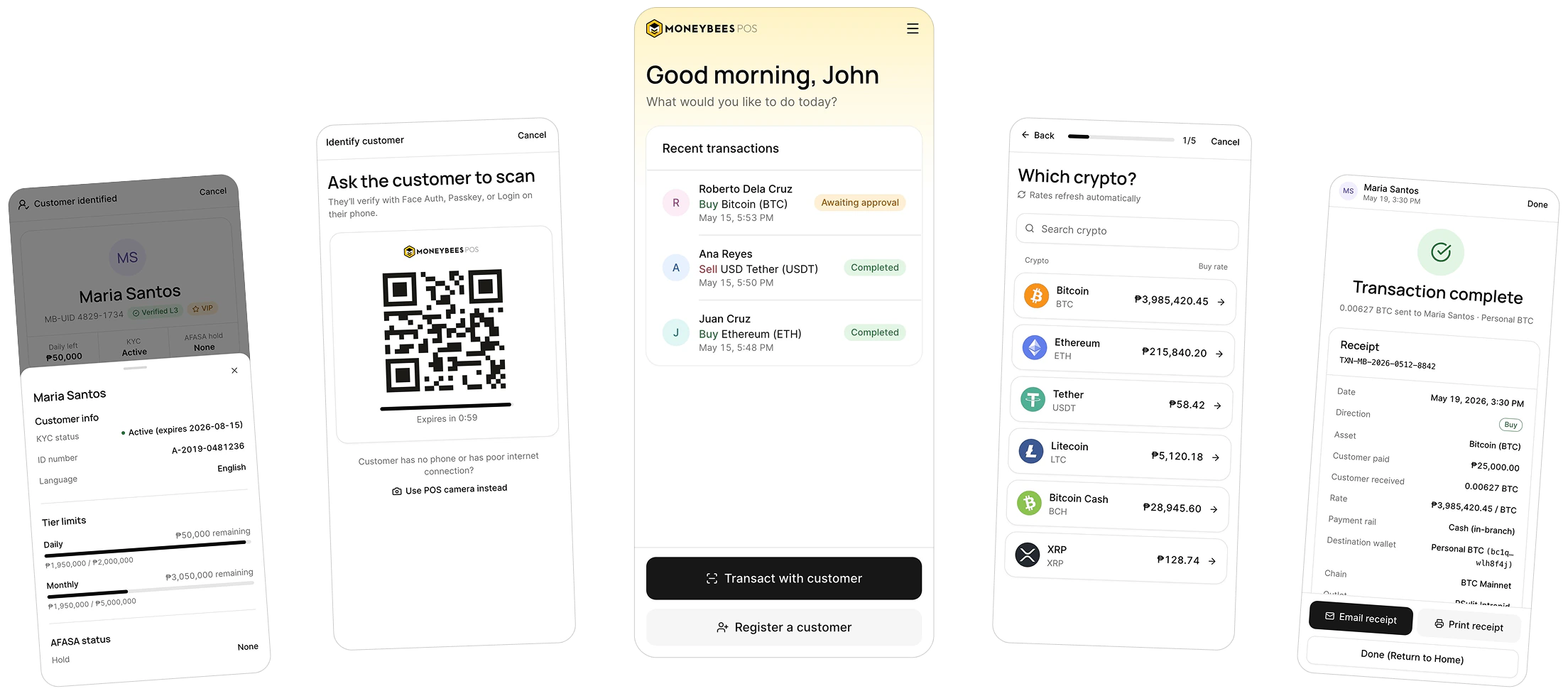
A teller experience built for real counter conditions
Hive POS is Moneybees’ in-branch application for over-the-counter crypto transactions. I redesigned the old Hive POS from the ground up around real teller workflows, covering UI/UX, user flows, prototyping, and the supporting design system.
The old workflow no longer matched how the counter needed to operate
What I learned from the outlets
I visited Moneybees outlets to observe real teller transactions, including how long they took, where people waited, and how connectivity affected the flow. Teller feedback was also collected through a Google Form.
The flow now starts with the customer and gives tellers a way to work around waiting instead of getting stuck in it.
- Select asset & rate
- Identify customer
- Enter amount
- Payment
- Receive crypto
- Submit
- Approval / processing
- Review
- Complete
- Identify customer
- Select asset & rate
- Enter amount
- Payment
- Receive crypto
- Review & submit
- Approval / processing
- If the transaction has to wait
- Park transaction
- Serve another
- Resume when ready
Waiting no longer blocks the counter. - Complete
Start with the customer, not the transaction
The old flow began with asset and rate selection before the teller had identified who they were serving. In the redesign, customer identification became the first step. QR pairing also moved authentication away from manually passing codes between the customer and teller.
Making each step easier to understand at a glance
I reorganized the transaction into clearer, focused screens with stronger action titles, better grouping, and fewer competing elements. The goal was to help tellers understand what they needed to do next without scanning through too much information at once.
Making every wait explain what is happening
I treated waiting as a series of clear states instead of a generic loading screen. Approval, processing, and completion each communicate what the transaction is waiting on and how far it has progressed.
The redesign became less about speed and more about keeping the counter moving
I couldn’t make network confirmations or approvals happen faster. What I could change was how the product handled them, starting with the customer, making each step clearer, giving waiting states meaning, and letting tellers keep serving customers while a transaction was pending.